Having lived in this part of town for almost three decades, I have often wondered on this blog the names of places and their histories. Often we live in a place and still do not know how it got its name.
Take Pusa Road. Of course it got its name from the Pusa Institute. In the early 80's that was the only building at the Pusa Road/Patel Nagar crossing. Beyond that it was all the ridge some of which had been cut out to make farmland for the agricultural institute.
But recently I found out that PUSA was actually a place in Bihar which was site for the earlier agricultural institute that was destroyed in the 1934 earthquake. The institute was then shifted to Delhi.
It struck me as funny the idea of naming an institute after a place. Normally gates of forts were named after places - Lahore gate or Ajmeri gate. These gates were the main points of departure to those places. But the Red Fort went a step ahead and had a Delhi gate which probably led to the city. Maybe they wanted to show that the fort was different from the city !
I am not sure what is the logic behind many of the names. Lodi Garden used to be Lady Willingdon Park till people reverted to the dynasty that created the tombs within the gardens. CP was named after the Duke of Connaught (he was lucky - three places in the world share the same name) and then they named it after Rajeev Gandhi. I am clueless about both choices.
But then there are pleasant surprises. There is Skinner's Church and Kwame Nkrumah Marg. The outer Ring Road in certain places is known as Gamal Abdel Nasser Marg. Trying to understand the names is like a lesson in history.
My award for the wierdest names goes to the Ulan Bator road. It is a short road that takes us to Delhi airport.
Showing posts with label history. Show all posts
Showing posts with label history. Show all posts
Saturday, April 18

Friday, February 8
Thames tunnel

The Thames tunnel was originally built below the river in London to solve traffic congestions way back in 1840. But due to a curious set of circumstances, it became part of an underground metro system dedicated to running trains and set the trend in other parts of the world.
It took nearly 15 years to excavate the tunnel which was a grand distance of 400 metres but it was unique engineering feat at that time. The construction had to be halted several times due to floods, tunnel collapses and lack of funds.
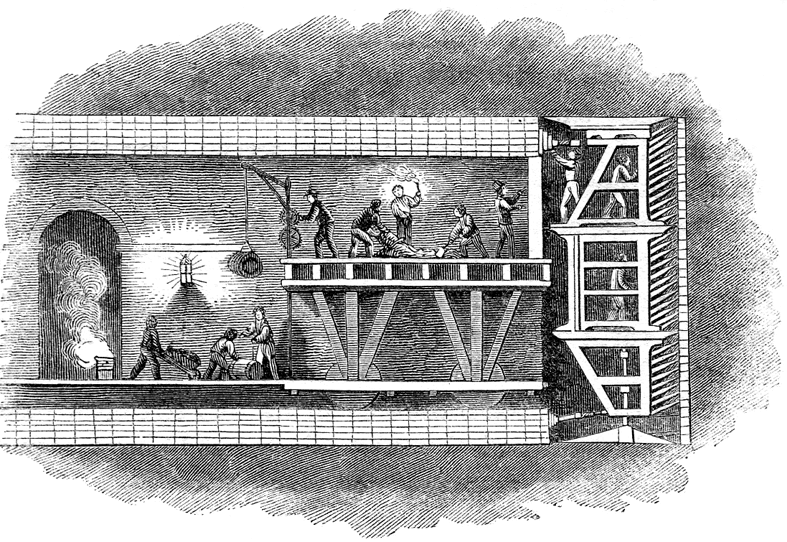
A special tunneling device called the tunneling shield made it possible for worker to dig through the soil while keeping them protected from collapses. It had a 36 cells each large enough to fit a worker who excavated a small area in front of him. Once the portion immediately in front of the workers was dug, the shield was pushed forward. Today the Delhi Metro is able to do the same distance in less than a month.
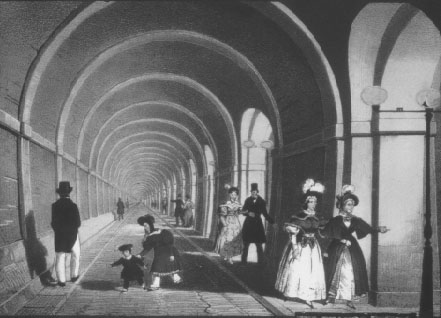
However when the tunnel was ready, carts could not use it since there were no ramps for them to enter and exit the tunnel due to a cash crunch! So it was used by pedestrians for over 20 years.
In the 1869 the tunnel was taken over by London Railway and finally it became part of the London Metropolitan Railway.
Tuesday, May 22
Karol Bagh history update
Dan Cherian points out :
Just saw your Mon, 14th May blog on Karol Bagh on the 0611metro website. Karol Bagh derives its name from a medieval orchard – Khillauli Bagh. Not Carol Bagh from the Christian population there.
Khillauli or Khiloli Bagh can be seen on older British maps when no suburb existed and can be seen as such till as recently as the 1807 ‘Sketch of the Environs of Delhi’ map (now reprinted commercially by the Survey of India). Over the later Mughal period, the larger orchard was repeatedly sub-divided and finally the purge of 1857 saw a suburb emerge. It became a large brick kiln area as well and quite a bit of the earlier stage construction material for British New Delhi.
Am not able to confirm that story. Would any of you dilliwalahs (or lahoris) be able help us out ?
Just saw your Mon, 14th May blog on Karol Bagh on the 0611metro website. Karol Bagh derives its name from a medieval orchard – Khillauli Bagh. Not Carol Bagh from the Christian population there.
Khillauli or Khiloli Bagh can be seen on older British maps when no suburb existed and can be seen as such till as recently as the 1807 ‘Sketch of the Environs of Delhi’ map (now reprinted commercially by the Survey of India). Over the later Mughal period, the larger orchard was repeatedly sub-divided and finally the purge of 1857 saw a suburb emerge. It became a large brick kiln area as well and quite a bit of the earlier stage construction material for British New Delhi.
Am not able to confirm that story. Would any of you dilliwalahs (or lahoris) be able help us out ?
Saturday, May 19
who is a commuter ?
Today we use the word for someone who travels. But how did the word come about? My friend had an interesting story. I checked it and it turned out to be true.
Here is the full definition, but for those in a hurry :
"Americans did not invent the suburbs, but they did create the commuter--someone who shuttles from a home in the suburbs to a job in the city and back again every day. Residing at a considerable distance from work was made possible by the invention of the railroad, and the name for someone who did so was made possible by the invention in the 1840s of a ticket good for multiple rides, the commutation ticket. Here commutation means "an exchange of one thing for another," especially if the new thing is a consolidation or reduction of the old. That is what the commutation ticket did: it exchanged individual tickets for a collective one at a lower price. The holder of such a ticket, being involved in the commutation, was thus called a commuter. Here is an 1865 exerpt from the Atlantic Monthly about railroads: "Two or three may be styled commuters' roads, running chiefly for the accommodation of city business-men with suburban residences."
In that statement we already see the modern connection of commuter with a lifestyle rather than a kind of ticket. Soon it no longer mattered whether the person held a commutation ticket, only where the person lived and worked. A commuter could ride a trolley, subway, cable car, or ferry as well as a train. In the twentieth century the commuter turned to the bus and automobile. "
now let me go and google metro and subway.
Monday, May 14
Carol Bagh

Walking thru Karol Bagh today, one can see a new set of tourists coming here. I am not talking about the Russians (15 years back they discovered K Bags as a haven for cheap clothes and ran a thriving export business). Most of the new ones come here to soak in Delhi's history.
They find it cheaper to stay here and travel by the metro. Ideally located (near CP and old Delhi) with the station and airport half-hour away.
Being close to the centre of the city, K Bags has always attracted different communities throughout the last century. Apparently it got its name from the numerous Christians who lived there and would take out processions on the street singing “Carols”. One locality - Regarhpura, houses members of the Reghar tribe, who were employed by the British as labourers in the construction of New Delhi.
After partition many of the refugees moved here. Later Bengalis, Tamilians and Malayalis have settled in droves with specialized shops catering to "Madrasis". Gaffar Market became an important place where we could buy all kinds of “smuggled” electronic goods and "imported" shoes.
By the late 90’s the market was a crowded urban jungle. Karol Bagh had become a concept.
Here is a letter by one Mr. Nalin Rai that I found (such are the joys of Internet) in a back issue of Down to Earth, where Karol Bagh is being evoked to explain out of control urbanization:
The article ‘High altitude sickness’ (Down To Earth, Vol 13, No 9, September 30, 2004) highlights the systematic rape of hills under the garb of tourism. Hill towns anywhere in the country have become an extension of the popular Karol Bagh market of New Delhi, both in the literal and metaphorical sense.
Now I hear that according to Master Plan 2021(???), the use of rickshaws is being planned to make Karol Bagh free of motorized traffic . Great news. One will walk safer in the market.
But I would like to warn you. Free of motorized traffic does not mean pedestrian friendly. Not in Karol Bagh. The place might become a live action video game with hawkers laying siege to the roads too - as it happens on Mondays each week.
Subscribe to:
Posts (Atom)